

When Was The Winters Tale Registered With The Stationer

Act II, scene 3: Antigonus swears his loyalty to Leontes, in an attempt to save Leontes' young daughter's life. From a painting past John Opie commissioned by the Boydell Shakespeare Gallery for printing and display.
The Wintertime'southward Tale is a play past William Shakespeare originally published in the First Folio of 1623. Although information technology was grouped amongst the comedies,[1] many modern editors have relabelled the play as one of Shakespeare's late romances. Some critics consider it to exist one of Shakespeare'south "problem plays" because the first three acts are filled with intense psychological drama, while the last two acts are comic and supply a happy ending.[ii]
The play has been intermittently popular, revived in productions in various forms and adaptations by some of the leading theatre practitioners in Shakespearean performance history, beginning after a long interval with David Garrick in his adaptation Florizel and Perdita (offset performed in 1753 and published in 1756). The Winter's Tale was revived again in the 19th century, when the fourth "pastoral" human activity was widely popular. In the second half of the 20th century, The Winter's Tale in its entirety, and fatigued largely from the First Page text, was often performed, with varying degrees of success.
Characters [edit]
| Sicilia
| Bohemia
Other Characters
|
Synopsis [edit]

An ink drawing of Act Ii, Scene 3: Paulina imploring Leontes to have mercy on his girl, Perdita. Illustration was designed for an edition of Lamb's Tales, copyrighted 1918.
Following a brief setup scene the play begins with the appearance of 2 childhood friends: Leontes, King of Sicily, and Polixenes, the King of Bohemia. Polixenes is visiting the kingdom of Sicilia, and is enjoying catching upwardly with his old friend. However, afterwards nine months, Polixenes yearns to render to his own kingdom to tend to diplomacy and see his son. Leontes desperately attempts to get Polixenes to stay longer, but is unsuccessful. Leontes then decides to send his wife, Queen Hermione, to try to convince Polixenes. Hermione agrees and with three brusque speeches is successful. Leontes is puzzled as to how Hermione convinced Polixenes then hands, and so he begins to suspect that his significant wife has been having an affair with Polixenes and that the child is Polixenes'. Leontes orders Camillo, a Sicilian Lord, to toxicant Polixenes. Camillo instead warns Polixenes and they both flee to Bohemia.
Furious at their escape, Leontes now publicly accuses his wife of infidelity, and declares that the child she is bearing must be illegitimate. He throws her in prison, over the protests of his nobles, and sends 2 of his lords, Cleomenes and Dion, to the Oracle at Delphos for what he is certain will exist confirmation of his suspicions. Meanwhile, the queen gives birth to a daughter, and her loyal friend Paulina takes the infant to the king, in the hopes that the sight of the kid volition soften his centre. He grows angrier, however, and orders Paulina's husband, Lord Antigonus, to take the child and abandon information technology in a desolate identify. Cleomenes and Dion return from Delphos with word from the Oracle and observe Hermione publicly and humiliatingly put on trial earlier the king. She asserts her innocence, and asks for the word of the Oracle to exist read before the courtroom. The Oracle states categorically that Hermione and Polixenes are innocent, Camillo is an honest man, and that Leontes volition accept no heir until his lost girl is plant. Leontes shuns the news, refusing to believe it as the truth. Every bit this news is revealed, discussion comes that Leontes' son, Mamillius, has died of a wasting sickness brought on by the accusations against his mother. At this, Hermione falls in a swoon, and is carried away by Paulina, who afterwards reports the queen'southward death to her heartbroken and repentant husband. Leontes vows to spend the rest of his days atoning for the loss of his son, his abandoned girl, and his queen.
Antigonus, meanwhile, abandons the baby on the coast of Bohemia, reporting that Hermione appeared to him in a dream and bade him name the girl Perdita. He leaves a fardel (a bundle) by the infant containing aureate and other trinkets which suggest that the baby is of noble blood. A vehement storm suddenly appears, wrecking the ship on which Antigonus arrived. He wishes to take compassion on the child, only is chased away in one of Shakespeare'south virtually famous stage directions: "Exit, pursued by a bear." Perdita is rescued past a shepherd and his son, also known as "Clown".
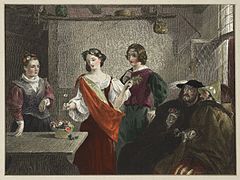
An engraving of Florizel and Perdita by Charles Robert Leslie.
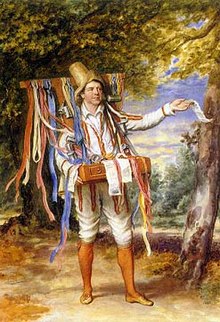
"Fourth dimension" enters and announces the passage of sixteen years. Camillo, now in the service of Polixenes, begs the Bohemian king to allow him to return to Sicilia. Polixenes refuses and reports to Camillo that his son, Prince Florizel, has fallen in love with a lowly shepherd girl: Perdita. He suggests to Camillo that, to take his mind off thoughts of home, they disguise themselves and attend the sheep-shearing feast where Florizel and Perdita will exist betrothed. At the banquet, hosted by the Sometime Shepherd who has prospered thanks to the gold in the fardel, the pedlar Autolycus picks the pocket of the Young Shepherd and, in diverse guises, entertains the guests with earthy songs and the trinkets he sells. Disguised, Polixenes and Camillo watch every bit Florizel (under the guise of a shepherd named Doricles) and Perdita are betrothed. Then, trigger-happy off the disguise, Polixenes angrily intervenes, threatening the Onetime Shepherd and Perdita with torture and death and ordering his son never to see the shepherd'due south daughter again. With the aid of Camillo, nonetheless, who longs to see his native land once again, Florizel and Perdita have transport for Sicilia, using the dress of Autolycus as a disguise. They are joined in their voyage past the One-time Shepherd and his son who are directed there by Autolycus.
In Sicilia, Leontes is still in mourning. Cleomenes and Dion plead with him to finish his fourth dimension of repentance because the kingdom needs an heir. Paulina, however, convinces the king to remain unmarried forever since no woman can friction match the greatness of his lost Hermione. Florizel and Perdita arrive, and they are greeted effusively past Leontes. Florizel pretends to exist on a diplomatic mission from his father, but his cover is blown when Polixenes and Camillo, also, arrive in Sicilia. The coming together and reconciliation of the kings and princes is reported past gentlemen of the Sicilian courtroom: how the Old Shepherd raised Perdita, how Antigonus met his end, how Leontes was overjoyed at being reunited with his daughter, and how he begged Polixenes for forgiveness. The Old Shepherd and Young Shepherd, now made gentlemen by the kings, meet Autolycus, who asks them for their forgiveness for his roguery. Leontes, Polixenes, Camillo, Florizel and Perdita and then go to Paulina'south house in the land, where a statue of Hermione has been recently finished. The sight of his married woman's class makes Leontes distraught, but and then, to everyone's amazement, the statue shows signs of vitality; information technology is Hermione, restored to life. As the play ends, Perdita and Florizel are engaged, and the whole company celebrates the miracle. Despite this happy ending typical of Shakespeare'southward comedies and romances, the impression of the unjust expiry of immature prince Mamillius lingers to the end, being an element of unredeemed tragedy, in addition to the years wasted in separation.
Sources [edit]

The chief plot of The Winter'due south Tale is taken from Robert Greene's pastoral romance Pandosto, published in 1588. Shakespeare'due south changes to the plot are uncharacteristically slight, especially in light of the romance's undramatic nature, and Shakespeare's fidelity to it gives The Winter's Tale its well-nigh distinctive feature: the xvi-year gap betwixt the third and quaternary acts.
In that location are minor changes in names, places, and minor plot details, but the largest changes prevarication in the survival and reconciliation of Hermione and Leontes (Greene's Pandosto) at the stop of the play. The character equivalent to Hermione in Pandosto dies after being accused of infidelity, while Leontes' equivalent looks back upon his deeds (including an incestuous fondness for his daughter) and slays himself. The survival of Hermione, while presumably intended to create the final scene'south insurrection de théâtre involving the statue, creates a distinctive thematic departure from Pandosto. Greene follows the usual ethos of Hellenistic romance, in which the render of a lost prince or princess restores order and provides a sense of sense of humor and closure that evokes Providence'due south control. Shakespeare, past dissimilarity, sets in the foreground the restoration of the older, indeed aged, generation, in the reunion of Leontes and Hermione. Leontes not just lives, but seems to insist on the happy ending of the play.
It has been suggested that the use of a pastoral romance from the 1590s indicates that at the end of his career, Shakespeare felt a renewed interest in the dramatic contexts of his youth. Minor influences also suggest such an involvement. As in Pericles, he uses a chorus to advance the action in the manner of the naive dramatic tradition; the apply of a bear in the scene on the Bohemian seashore is near certainly indebted to Mucedorus,[iii] a chivalric romance revived at court around 1610.

Scene from 'The Winter's Tale' (Act IV, Scene 4) (from the play past William Shakespeare), Augustus Leopold Egg (1845)
Eric Ives, the biographer of Anne Boleyn (1986),[4] believes that the play is really a parallel of the fall of the queen, who was beheaded on false charges of adultery on the orders of her husband Henry VIII in 1536. At that place are numerous parallels between the two stories – including the fact that ane of Henry'south closest friends, Sir Henry Norreys, was beheaded as one of Anne's supposed lovers and he refused to confess in lodge to salve his life, claiming that everyone knew the Queen was innocent. If this theory is followed then Perdita becomes a dramatic presentation of Anne'south only daughter, Queen Elizabeth I.
Date and text [edit]
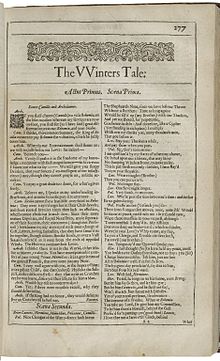
The start page of The VVinters Tale, printed in the 2nd Folio of 1632
The play was non published until the Beginning Folio of 1623. In spite of tentative early on datings (see below), nigh critics believe the play is one of Shakespeare'due south later works, perhaps written in 1610 or 1611.[5] A 1611 engagement is suggested past an apparent connectedness with Ben Jonson's Masque of Oberon, performed at Courtroom 1 Jan 1611, in which appears a dance of ten or twelve satyrs; The Winter's Tale includes a dance of twelve men costumed as satyrs, and the retainer announcing their entry says "one three of them, by their own study, sir, hath danc'd before the King." (IV.iv.337–338). Arden Shakespeare editor J.H.P. Pafford found that "the language, style, and spirit of the play all point to a belatedly date. The tangled spoken language, the packed sentences, speeches which brainstorm and finish in the eye of a line, and the loftier percentage of light and weak endings are all marks of Shakespeare's writing at the end of his career. Only of more than importance than a verse test is the similarity of the final plays in spirit and themes."[vi]
In the belatedly 18th century, Edmond Malone suggested that a "book" listed in the Stationers' Register on 22 May 1594, under the title "a Wynters nightes pastime", might have been Shakespeare's, though no copy of information technology is known.[7] In 1933, Dr. Samuel A. Tannenbaum wrote that Malone afterward "seems to accept assigned it to 1604; later still, to 1613; and finally he settled on 1610–11. Hunter assigned it to virtually 1605."[8]
Assay and criticism [edit]
Title of the play [edit]
A play called "The Wintertime'southward Tale" would immediately betoken to contemporary audiences that the work would present an "idle tale", an old wives' tale non intended to be realistic and offering the promise of a happy ending. The championship may accept been inspired past George Peele's play The Old Wives' Tale of 1590, in which a storyteller tells "a merry winter'southward tale" of a missing girl.[9] [10] Early on in The Winter's Tale, the majestic heir, Mamillius, warns that "a sad tale's best for winter".[11] His mother is shortly put on trial for treason and adultery – and his death is announced seconds after she is shown to accept been true-blue and Leontes's accusations unfounded.
Debates [edit]
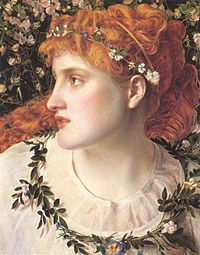

A mid-19th-century painting of the statue of Hermione coming to life
The statue [edit]
While the linguistic communication Paulina uses in the final scene evokes the sense of a magical ritual through which Hermione is brought back to life, there are several passages which suggest a far likelier instance – that Paulina hid Hermione at a remote location to protect her from Leontes' wrath and that the re-animation of Hermione does not derive from whatever magic. The Steward announces that the members of the court accept gone to Paulina's dwelling to come across the statue; Rogero offers this exposition: "I idea she had some great matter there in hand, for she [Paulina] hath privately twice or thrice a solar day, ever since the death of Hermione, visited that removed house" (5.2. 102–105). Further, Leontes is surprised that the statue is "and so much wrinkled", different the Hermione he remembers. Paulina answers his business by challenge that the age-progression attests to the "carver's excellence", which makes her look "every bit [if] she lived now". Hermione later asserts that her want to see her daughter allowed her to endure 16 years of separation: "m shalt hear that I, / Knowing by Paulina that the oracle / Gave hope k wast in being, have preserved / Myself to see the issue" (5.iii.126–129).
However, the action of three.2 calls into question the "rational" explanation that Hermione was spirited away and sequestered for 16 years. Hermione swoons upon the news of Mamilius' death, and is rushed from the room. Paulina returns after a short monologue from Leontes, bearing the news of Hermione'southward death. After some discussion, Leontes demands to be led toward the bodies of his wife and son: "Prithee, bring me / To the dead bodies of my queen and son: / One grave shall exist for both: upon them shall / The causes of their death appear, unto / Our shame perpetual" (3.2). Paulina seems convinced of Hermione'south decease, and Leontes' guild to visit both bodies and see them interred is never called into question by later events in the play.
The seacoast of Bohemia [edit]

Shakespeare'due south swain playwright Ben Jonson ridiculed the presence in the play of a seacoast and a desert in Bohemia, since the Kingdom of Bohemia (which roughly corresponds to the western part of the modern-day Czech Democracy) had neither a coast (being landlocked) nor a desert.[12] [13] Shakespeare followed his source (Robert Greene'due south Pandosto) in giving Bohemia a coast, though he reversed the location of characters and events: "The part of Pandosto of Bohemia is taken by Leontes of Sicily, that of Egistus of Sicily by Polixenes of Bohemia".[xiv] In back up of Greene and Shakespeare, it has been pointed out that in the 13th century, for a period of less than almost ten years, under Ottokar Two of Bohemia, the territories ruled by the king of Bohemia, although never incorporated into the kingdom of Bohemia, did stretch to the Adriatic, and, if 1 takes "Bohemia" to hateful all of the territories ruled by Ottokar II, it is possible to argue that i could sail from a kingdom of Sicily to the "seacoast of Bohemia".[fifteen] [16] Jonathan Bate offers the unproblematic caption that the court of King James was politically centrolineal with that of Rudolf II, and the characters and dramatic roles of the rulers of Sicily and Bohemia were reversed for reasons of political sensitivity, and in particular to allow it to be performed at the wedding of the Princess Elizabeth.[17]
In 1891, Edmund Oscar von Lippmann pointed out that "Bohemia" was also a rare name for Apulia in southern Italia.[18] More influential was Thomas Hanmer's 1744 argument that Bohemia is a printed fault for Bithynia, an aboriginal nation in Asia Minor;[19] this theory was adopted in Charles Kean'due south influential 19th-century product of the play, which featured a resplendent Bithynian court. At the time of the medieval Kingdom of Sicily, however, Bithynia was long extinct and its territories were controlled by the Byzantine Empire. On the other hand, the play alludes to Hellenistic antiquity (eastward.g. the Oracle of Delphos, the names of the kings), so that the "Kingdom of Sicily" may refer to Greek Sicily, not to the Kingdom of Sicily of later medieval times.
The pastoral genre is not known for precise verisimilitude, and, like the assortment of mixed references to ancient religion and contemporary religious figures and customs, this possible inaccuracy may take been included to underscore the play'south fantastical and chimeric quality. Every bit Andrew Gurr puts it, Bohemia may have been given a seacoast "to flout geographical realism, and to underline the unreality of place in the play".[20]
A theory explaining the existence of the seacoast in Bohemia offered by C. H. Herford is suggested in Shakespeare's chosen title of the play. A winter's tale is something associated with parents telling children stories of legends around a fireside: past using this title, information technology implies to the audience that these details should non be taken as well seriously.[21]
John A. Pitcher argues in the Arden Shakespeare Third Series edition (2010) that the coast of Bohemia is intended as a joke, akin to jokes about a "Swiss Navy."[22]
In the novel Prince Otto by Robert Louis Stevenson reference is made to the land of Seaboard Bohemia in the context of an obvious parody of Shakespeare's apparent liberties with geography in the play.
The Isle of Delphos [edit]
Likewise, Shakespeare's credible fault of placing the Oracle of Delphi on a small island has been used as evidence of Shakespeare's limited education. However, Shakespeare again copied this locale directly from "Pandosto". Moreover, the erudite Robert Greene was non in mistake, equally the Isle of Delphos does non refer to Delphi, merely to the Cycladic isle of Delos, the mythical birthplace of Apollo, which from the 15th to the belatedly 17th century in England was known as "Delphos".[23] Greene's source for an Apollonian oracle on this island likely was the Aeneid, in which Virgil wrote that Priam consulted the Oracle of Delos earlier the outbreak of the Trojan War and that Aeneas later on escaping from Troy consulted the aforementioned Delian oracle regarding his future.[24]
The behave [edit]

An 1807 print of Act III, Scene iii: Leave Antigonus chased by a acquit.
The play contains the about famous of Shakespearean stage directions: Get out, pursued by a behave, presaging the offstage death of Antigonus. Information technology is not known whether Shakespeare used a real bear from the London bear-pits,[25] or an actor in bear costume. The Admiral's Men, the rival playing visitor to the Lord Chamberlain's Men during the 1590s, are reported to have possessed "j beares skyne" among their phase backdrop in a surviving inventory dated March 1598. Perhaps a similar prop was later used by Shakespeare'south visitor.
The Purple Shakespeare Company, in one production of this play, used a large sheet of silk which moved and created shapes to symbolise both the bear and the gale in which Antigonus is travelling.
Dildos [edit]
One comic moment in the play deals with a retainer not realising that poetry featuring references to dildos is vulgar, presumably from not knowing what the word means. This play and Ben Jonson'southward play The Alchemist (1610) are typically cited as the starting time usage of the word in publication.[26] The Alchemist was printed beginning, just the debate virtually the date of the play's composition makes information technology unclear which was the first scripted use of the give-and-take, which is much older.[27]
Performance history [edit]

A delineation of Mrs. Mattocks as Hermione, from a 1779 operation at the Theatre Royal in Drury Lane
The primeval recorded functioning of the play was recorded past Simon Forman, the Elizabethan "figure caster" or astrologer, who noted in his journal on xi May 1611 that he saw The Winter's Tale at the World playhouse. The play was and then performed in front of Rex James at Courtroom on v November 1611. The play was too acted at Whitehall during the festivities preceding Princess Elizabeth's marriage to Frederick V, Elector Palatine, on 14 Feb 1613. Later Court performances occurred on 7 April 1618, xviii January 1623 and sixteen January 1634.[28]
The Wintertime's Tale was non revived during the Restoration, different many other Shakespearean plays. It was performed in 1741 at Goodman's Fields Theatre and in 1742 at Covent Garden. Adaptations, titled The Sheep-Shearing and Florizal and Perdita, were acted at Covent Garden in 1754 and at Drury Lane in 1756.[29]
I of the best remembered modern productions was staged by Peter Brook in London in 1951 and starred John Gielgud as Leontes. Other notable stagings featured John Philip Kemble in 1811, Samuel Phelps in 1845 and Charles Kean in an 1856 production that was famous for its elaborate sets and costumes. Johnston Forbes-Robertson played Leontes memorably in 1887, and Herbert Beerbohm Tree took on the function in 1906. The longest-running Broadway product[thirty] starred Henry Daniell and Jessie Royce Landis and ran for 39 performances in 1946. In 1980, David Jones, a onetime associate artistic director of the Royal Shakespeare Company chose to launch his new theatre visitor at the Brooklyn University of Music (BAM) with The Wintertime's Tale starring Brian Murray supported by Jones' new company at BAM[31] In 1983, the Riverside Shakespeare Company mounted a production based on the Commencement Page text at The Shakespeare Center in Manhattan. In 1993 Adrian Noble won a Globe Award for Best Director for his Royal Shakespeare Company adaptation, which then was successfully brought to the Brooklyn Academy of Music in 1994.[32]
In 2009, 4 separate productions were staged:
- Sam Mendes inaugurated his transatlantic "Bridge Projection" directing The Wintertime's Tale with a bandage featuring Simon Russell Beale (Leontes), Rebecca Hall (Hermione), Ethan Hawke (Autolycus), Sinéad Cusack (Paulina), and Morven Christie (Perdita).
- The Majestic Shakespeare Company[33]
- Theatre Delicatessen[34] also staged productions of The Winter's Tale in 2009. The play is in the repertory of the Stratford Festival of Canada and was seen at the New York Shakespeare Festival, Central Park, in 2010.
- The Hudson Shakespeare Visitor of New Jersey presented a product as part of their annual Shakespeare in the Parks series. The activity was set in central Europe during the early 1900s era of the Austria-hungary only with a decidedly diverse cast. African American actors Tony White played Leontes, Deirdre Ann Johnson played Hermione, and Monica Jones in a dual part of Mamillius and Perdita. Also, rounding out the various cast was Angela Liao as Paulina.[35]
In 2013 the RSC staged a new production directed by Lucy Bailey, starring Jo Stone-Fewings as Leontes and Tara Fitzgerald as Hermione.[36] This product premiered on 24 January at the Majestic Shakespeare Theatre on 24 January 2013.[36]
In 2015, the Kenneth Branagh Production visitor staged the play at the Garrick Theatre, with simultaneous broadcast to cinemas. The production featured Kenneth Branagh as Leontes, Judi Dench as Paulina, and Miranda Raison as Hermione.[37]
Likewise in 2015, Cheek past Jowl staged the play, directed past Declan Donnellan and designed by Nick Ormerod. The production toured to French republic, Kingdom of spain, the United states and Russian federation among others. In a partnership with the BBC and Riverside Studios the product was livestreamed all around the earth. [38]
In 2017 The Public Theatre Mobile Unit staged the play, directed by Lee Sun Evans.[39]
In 2018 Theatre for a New Audience staged the play Off-Broadway, directed by Arin Arbus with Kelley Curran as Hermione and Anatol Yusef as King Leontes.[twoscore]
In 2018, the play was also performed at Shakespeare's Globe, in London.
Adaptations [edit]
In that location have been numerous picture versions, including a 1910 silent film,[41] a 1961 television film starring Robert Shaw, and a 1967 version starring Laurence Harvey equally Leontes.[42]
An "orthodox" BBC production was televised in 1981. It was produced by Jonathan Miller, directed past Jane Howell and starred Robert Stephens as Polixenes and Jeremy Kemp equally Leontes.[43]
Choreographer Christopher Wheeldon created a full-length ballet, with music by Joby Talbot, based on the play. The ballet is a co-production between The Imperial Ballet and National Ballet of Canada, and premiered in Royal Opera House in London in 2014.[44]
In 2015, writer Jeanette Winterson published the book The Gap of Time, a modern adaptation of The Winter'southward Tale.[45]
In 2016, author E. Yard. Johnston published the volume Get out, Pursued by a Acquit, a modernistic adaption of The Winter'due south Tale.[46]
On 1 May 2016, BBC Radio 3'due south Drama on iii broadcast a production directed by David Hunter, with Danny Sapani as Leontes, Eve All-time every bit Hermione, Shaun Dooley as Polixenes, Karl Johnson every bit Camillo, Susan Jameson as Paulina, Paul Copley as the Shepherd and Faye Castelow equally Perdita.[47]
An opera by Ryan Wigglesworth, based on the play, was premiered at the English National Opera on 27 February 2017.[48]
In 2021 Melbourne Shakespeare Company produced an abridged musical production directed past Jennifer Sarah Dean[49] at Cardinal Park in Melbourne.
References [edit]
- ^ WT comes last, following Twelfth Night which uncharacteristically ends with a blank recto folio, suggesting to Arden editor J.H.P. Pafford there was some hesitation as to where WT belonged at the time of printing the Folio. (J.H.P. Pafford, ed. The Winter's Tale (Arden Shakespeare) 3rd ed. 1933:15–xvii.)
- ^ William W. Lawrence, Shakespeare's Problem Comedies, New York, Macmillan, 1931; pp. 9–13 .
- ^ C. F. Tucker Brooke, The Shakespeare Apocrypha, Oxford, Clarendon Press, 1908; pp. 103–126.
- ^ Ives, The Life and Expiry of Anne Boleyn 2004:421: in spite of other scholars' rejection of whatever parallels betwixt Henry VIII and Leontes, asserts "the parallels are in that location", noting his article "Shakespeare and History: divergencies and agreements", in Shakespeare Survey 38 (1985:19–35), p 24f.
- ^ F. E. Halliday, A Shakespeare Companion 1564–1964, Baltimore, Penguin, 1964; p. 532.
- ^ Pafford, J.H.P., ed. "Introduction", The Winter's Tale Arden Shakespeare second. serial (1963, 1999), xxiii.
- ^ Malone, Edmond. "An Attempt to Ascertain the Order in which the Plays Attributed to Shakspeare Were Written," The Plays and Poems of William Shakespeare in Ten Volumes. Eds. Samuel Johnson and George Steevens. 2nd ed. London, 1778, Vol. I: 269–346; 285.
- ^ Tannenbaum, "The Forman Notes", Shakespearean Scraps, 1933
- ^ John Olde (one of the translators of Udall's New Testament) in 1556: "olde wiues fables and wintertime tales". Cited in "winter, 5a". Oxford English Dictionary (2nd ed.). 1989.
- ^ Bate, Jonathan; Rasmussen, Eric (2007). Complete Works. London: Macmillan. p. 698. ISBN978-0-230-00350-vii.
- ^ Human activity 2 scene ane
- ^ Wylie, Laura J., ed. (1912). The Winter's Tale. New York: Macmillan. p. 147. OCLC 2365500.
Shakespeare follows Greene in giving Bohemia a seacoast, an error that has provoked the word of critics from Ben Jonson on.
- ^ Ben Jonson, 'Conversations with Drummond of Hawthornden', in Herford and Simpson, ed. Ben Jonson, vol. one, p. 139.
- ^ Greene's 'Pandosto' or 'Dorastus and Fawnia': beingness the original of Shakespeare'due south 'Winter's tale', P. G. Thomas, editor. Oxford University Press, 1907
- ^ Meet J. H. Pafford, ed. The Wintertime's Tale, Arden Edition, 1962, p. 66
- ^ Fermor, Patrick (1977). A Fourth dimension of Gifts. London: John Murray. p. 258. ISBN0719566959.
- ^ Bate, Jonathan (2008). "Shakespeare and Jacobean Geopolitics". Soul of the Historic period. London: Viking. p. 305. ISBN978-0-670-91482-1.
- ^ Edmund O. von Lippmann, 'Shakespeare's Ignorance?', New Review 4 (1891), 250–254.
- ^ Thomas Hanmer, The Works of Shakespeare (Oxford, 1743–44), vol. 2.
- ^ Andrew Gurr, 'The Bear, the Statue, and Hysteria in The Winter's Tale, Shakespeare Quarterly 34 (1983), p. 422.
- ^ Come across C.H. Herford, ed. The Winter's Tale, The Warwick Shakespeare edition, p.15.
- ^ "Swiss Navy Joke Vanishing Every bit This All-Fools' Day Dawns." The New York Times, April i, 1927. https://world wide web.nytimes.com/1927/04/01/archives/swiss-navy-joke-vanishing-as-this-allfools-day-dawns.html
- ^ Terence Spencer, Shakespeare's Isle of Delphos, The Modernistic Language Review, Vol. 47, No. 2 (Apr., 1952), pp. 199–202.
- ^ Virgil, Aeneid, In. 73–101
- ^ The main comport-garden in London was the Paris Garden at Southwark, near the Globe Theatre.
- ^ Run across, for instance, "dildo1". OED Online (2nd ed.). Oxford: Oxford University Press. 1989. Retrieved 21 Apr 2009. , which cites Jonson's 1610 edition of The Alchemist ("Here I find ... The seeling fill'd with poesies of the candle: And Madame, with a Dildo, writ o' the walls.": Act V, scene three) and Shakespeare'southward The Winter's Tale (dated 1611, "He has the prettiest Loue-songs for Maids ... with such delicate burthens of Dildo's and Fadings.": Deed IV, scene four).
- ^ The start reference in the Oxford English language Dictionary is Thomas Nashe'due south The Choise of Valentines or the Merie Ballad of Nash his Dildo (c. 1593); in the 1899 edition, the following sentence appears: "Curse Eunuke dilldo, senceless counterfet."
- ^ All dates new style.
- ^ Halliday, pp. 532–533.
- ^ Four previous productions in New York, the primeval that of 1795 are noted in the Internet Broasdway Database; The Winter's Tale has not played on Broadway since 1946.
- ^ "Brooklyn Bets on Rep", T. Eastward. Kalem, Time, three March 1980
- ^ "Critics Notebook", Ben Brantley, The New York Times, 22 April 1994.
- ^ "RSC listing". Rsc.org.united kingdom of great britain and northern ireland. Archived from the original on 28 September 2008. Retrieved v Jan 2012.
- ^ Francesca Whiting (23 Apr 2009). "The Stage review of [Theatre Delicatessen]'s The Winter's Tale". Thestage.co.britain. Retrieved five January 2012.
- ^ "Hudson Shakespeare Company Returns". The Connecticut Post. 26 June 2009.
- ^ a b "Tara Fitzgerald To Make RSC Debut in Lucy Bailey's The Winter's Tale". Royal Shakespear Company. Archived from the original on 20 May 2014. Retrieved 20 May 2014.
- ^ Billington, Michael (8 Nov 2015). "The Winter's Tale review – Kenneth Branagh and Judi Dench offer intriguing touches". The Guardian. ISSN 0261-3077. Retrieved i July 2017.
- ^ "The Winter's Tale".
- ^ "Mobile Unit: The Winter'due south Tale". The Public Theatre. Retrieved 25 April 2018.
- ^ "Theatre for a New Audition'due south the Wintertime'southward Tale Begins Off-Broadway". 13 March 2018.
- ^ |The Winter's Tale (1910)
- ^ The Wintertime's Tale (1968)
- ^ "The Wintertime's Tale (1981, Idiot box)". IMDB. Retrieved 22 January 2010.
- ^ Jennings, Luke (12 April 2014). "The Winter'southward Tale review – 'a ballet to keep'". The Guardian. Guardian News and Media Limited. Retrieved iii June 2014.
- ^ "The Gap of Fourth dimension".
- ^ "EXIT, PURSUED BY A BEAR". Kirkus Reviews. 8 December 2015. Retrieved 5 July 2016.
- ^ "Drama on 3, the Winter's Tale". BBC Radio 3.
- ^ Chanteau, Clara. The Winter'south Tale , ENO, London, review, The Independent online, 28 February 2017, retrieved fifteen March 2017.
- ^ "The Winter's Tale". Australian Arts Review. ane March 2021. Retrieved 5 May 2021.
Sources [edit]
- Brooke, C. F. Tucker. 1908. The Shakespeare Apocrypha, Oxford, Clarendon printing, 1908; pp. 103–126.
- Chaney, Edward, The Development of the Thou Tour: Anglo-Italian Cultural Relations since the Renaissance 2nd ed.(Routledge, 2000).
- Gurr, Andrew. 1983. "The Bear, the Statue, and Hysteria in The Wintertime's Tale", Shakespeare Quarterly 34 (1983), p. 422.
- Halliday, F. E. 1964. A Shakespeare Companion 1564–1964, Baltimore, Penguin, 1964; p. 532.
- Hanmer, Thomas. 1743. The Works of Shakespeare (Oxford, 1743–44), vol. two.
- Isenberg, Seymour. 1983. "Sunny Winter", The New York Shakespeare Society Bulletin, (Dr. Bernard Beckerman, Chairman; Columbia University) March 1983, pp. 25–26.
- Jonson, Ben. "Conversations with Drummond of Hawthornden", in Herford and Simpson, ed. Ben Jonson, vol. 1, p. 139.
- Kalem, T. Due east. 1980. "Brooklyn Bets on Rep", Time Magazine, iii March 1980.
- Lawrence, William W. 1931. Shakespeare'due south Problem Comedies, Macmillan, New York. OCLC 459490669
- Von Lippmann, Edmund O. 1891. "Shakespeare'south Ignorance?", New Review 4 (1891), 250–254.
- McDowell, W. Stuart. 1983. Managing director's note in the plan for the Riverside Shakespeare Visitor production of The Winter'southward Tale, New York City, 25 February 1983.
- Pafford, John Henry Pyle. 1962, ed. The Winter's Tale, Arden Edition, 1962, p. 66.
- Tannenbaum, Dr. Samuel A. 1933. " Shakespearean Scraps", chapter: "The Forman Notes" (1933).
- Verzella, Massimo, "Iconografia femminile in The Wintertime's Tale", Merope, XII, 31 (sett chism and anti-Petrarchism in The Winter's Tale" in Merope, numero speciale dedicato agli Studi di Shakespeare in Italia, a cura di Michael Hattaway due east Clara Mucci, XVII, 46–47 (Set. 2005– Gen. 2006), pp. 161–179.
External links [edit]
- Winters Tale at Project Gutenberg
- Scans of the First Folio version of the play
- The Winters Tale – HTML version of this title.
-
 The Wintertime'south Tale public domain audiobook at LibriVox
 - A thorough (open source) concordance of all of Shakespeare'due south plays
- Gear up Design for the 1948 production at the Imperial Shakespeare Theatre – Motley Collection of Theatre & Costume Design

When Was The Winters Tale Registered With The Stationer,
Source: https://en.wikipedia.org/wiki/The_Winter%27s_Tale#:~:text=In%20the%20late%2018th%20century,Samuel%20A.
Posted by: sanchezsmorturtmare40.blogspot.com
0 Response to "When Was The Winters Tale Registered With The Stationer"
Post a Comment